Showing posts with label Seven Trumpets. Show all posts

Wednesday, July 25, 2012

The Last Trumpet

Reflections on Revelation 11:15-19

When the seventh trumpet sounds, the holy people are no longer broken, the holy city is no longer trampled by the nations, and the nations rage no longer.  The saints possess the kingdom because the kingdom of the world has become the kingdom of our Lord and his Christ.  The Lord God Almighty has taken his great power and begun to reign.  He judges the dead, rewarding his servants and destroying the destroyers who killed the saints and plundered the earth to satisfy their greed.  More than that, the saints enter the presence of God and dwell there for the temple in heaven is opened revealing the ark of his covenant, which contains God's promises of redemption and salvation for his people.

The seven trumpet blasts assure the saints that God hears their prayers when they are hurting.  Even now, he is pouring out plagues on the wicked.  Because of these plagues, the wicked may heap greater afflictions upon the saints, but the stubborn rebellion of the wicked vindicates God's eventual punishment.   God will deliver the saints, just as he did the Israelites.

Just as the vision of the seven seals ends with the judgment of the nations at the return of Christ, so also the vision of the seven trumpets ends with the judgment of the nations at the return of Christ.

Monday, July 16, 2012

Armies of Evil Spiritual Powers

Reflections on Revelation 9:13-21

When the angel blows the sixth trumpet, a voice speaks to him from the horns of the golden altar.  In the earthly tabernacle, the golden altar was the altar of incense, which stood immediately in front of the curtain separating the Holy Place from the Most Holy Place (Exodus 30:1 ff.).  Incense was offered daily on this altar, and the blood of a sin offering on the Day of Atonement was sprinkled on the horns of this altar once a year (Exodus 30:10; cf. Leviticus 4:7).  In the heavenly temple, the prayers of the saints are offered on the golden altar (Revelation 8:3), and the blood of Slain Lamb on the horns of that altar also pleads the cause of the saints and commands that the four angels bound at the great river Euphrates be set loose.

A vast army numbering 200,000,000 is unleashed on impenitent mankind and kills a third of them.  In the Old Testament, God sent the armies of Assyria and Babylonia, which were beyond the Euphrates, to discipline an impenitent Israel which had given itself to idolatry, violence, and theft. Here, the armies attack those who persecute God's people, but they do not repent.  Their impenitence vindicates God's coming judgment. 

Every war has a spiritual dimension.  In the sixth seal, the armies are the agents of evil nations, yet God uses them again to accomplish his divine purpose just as God used Assyria and Babylonia. 

I have seen similar things in my own lifetime.  Evil spiritual forces were certainly behind the attacks on the World Trade Center and the Pentagon on September 11, 2001.  They should have served as a warning to the ungodly of our nation who promote and profit from pornography, convict those who oppose ungodly lifestyles of hate crimes, scoff at those who honor marriage, despise those who oppose abortion, arrest those who pray in public, and denounce the preaching of Christ as intolerance.  The attacks did not halt our nation's slide into unrighteousness.  If greater disasters destroy our nation in the future, the failure to change our sinful ways will fully justify God's judgment.  Like Habakkuk, we may wonder why God uses such evil nations to accomplish his purpose, but we must trust God's plan. 

Friday, July 13, 2012

A Plague of Spiritual Delusions

Inscription for a pagan temple
marked out with a cross
Reflections on Revelation 9:1-12

The fifth trumpet sounds, and a star falls from heaven to earth.  The star is given the key to open the bottomless pit, which is the abode of evil spiritual forces.  The great smoke that ascends from the bottomless pit is spiritual deception and wickedness that darkens the light of God in this world (Hendriksen, 1967, p. 145).  Locusts come from the smoke, but instead of destroying grass, trees, and all that is green as the locusts did in Egypt, they harm only people who do not have the seal of God on their foreheads.  The pain of sin and rebellion against God is said to be like the sting of a scorpion.  This plague is permitted to continue only five months.

Unlike locusts of the earth, these locusts have a king over them who is the angel of the bottomless pit called Abaddon or Apollyon.  The first name is in Hebrew and the second in Greek.  Both names mean Destroyer.
 
The fifth trumpet blast is the first of three woes (Revelation 9:13).  It is not merely a physical plague, but the powers of darkness are unleashed and used by God to accomplish his will.  The locusts are allowed to harm only those without the seal of God on their foreheads. The saints, like the Israelites in Egypt, are protected from the plagues.

Wednesday, July 11, 2012

The Lord Defends the Saints

Reflections on Revelation 8:6-14

What is the significance of the blowing of the seven trumpets in this vision? In the Old Testament, God commanded the Israelites to make trumpets to call assemblies, to announce the Day of Atonement, and to call Israel to battle (Numbers 10:1-10). God promised to remember Israel and to fight for them when he heard the trumpet blasts.
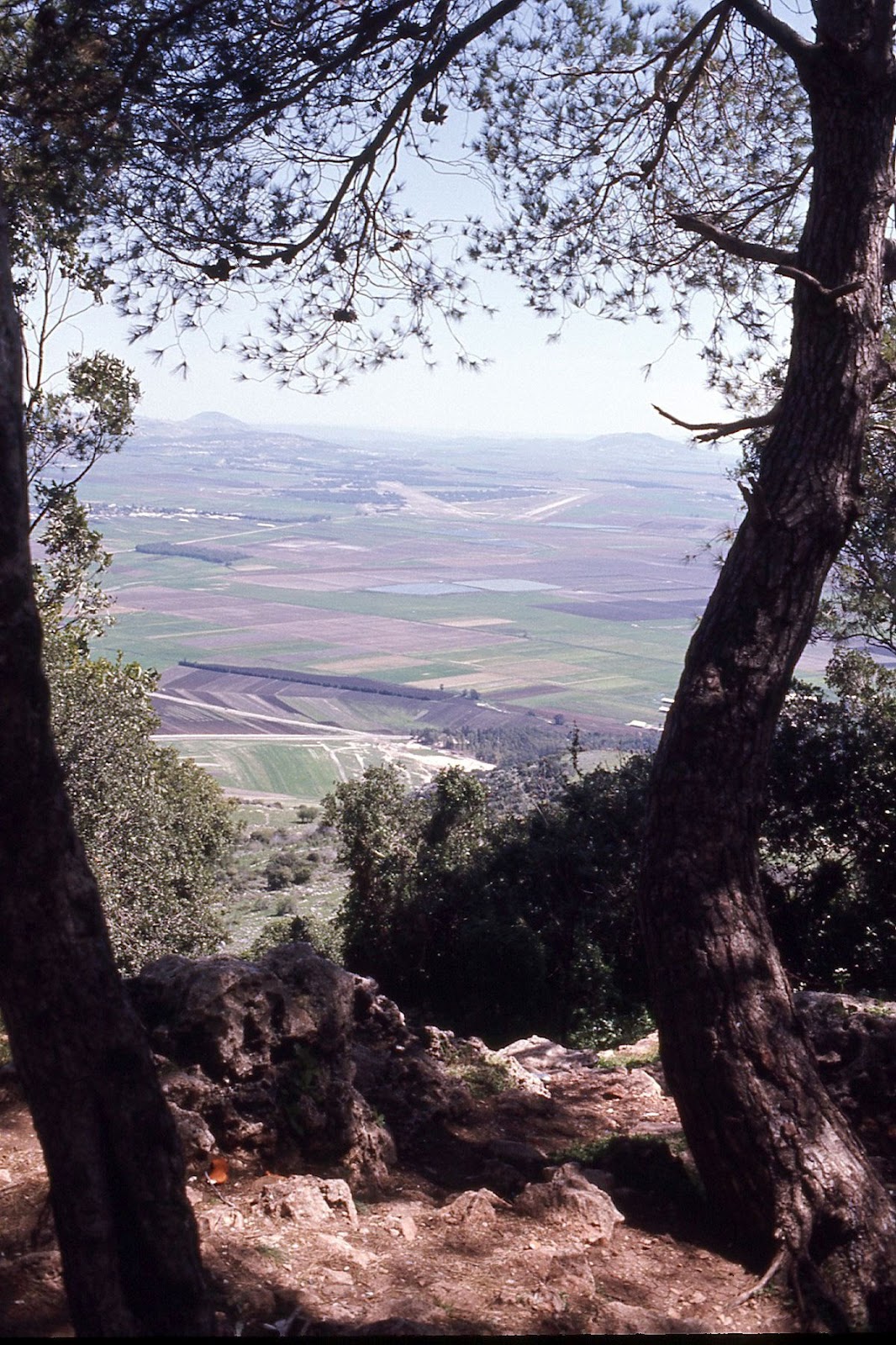
View of Plain
from Mt. Carmel
And when you go to war in your land against the adversary who oppresses you, then you shall sound an alarm with the trumpets, that you may be remembered before the LORD your God, and you shall be saved from your enemies. -- Numbers 10:9 ESV
Accordingly, Israel marched into battle against Balaam and the Midianites to the sound of trumpets, and God gave them victory (Num 31:1-7). God leveled the walls of Jericho when the trumpets were blown in the days of Joshua (Joshua 6:20). Gideon and 300 men blew trumpets and defeated an army as numberless as the sand of the sea (Judges 7:8). Nehemiah assured those working on the walls of Jerusalem that God would fight for them when they were attacked if they sounded the trumpets (Nehemiah 4:20). The trumpet blasts assure suffering saints that God will fight for them.

The trumpet blasts also assure the suffering saints that they will be victorious because the Lord will send out angels to gather them with a loud trumpet call (Matthew 24:31), and at that last trumpet call, the dead will be raised (1 Corinthians 15:52; 1 Thessalonians 4:16).

Each of the first four trumpet calls brings a plague on the earth similar to one of the plagues that fell on the Egyptians when God chastised them for afflicting his firstborn son (Exodus 4:22-23). He responds similarly against those afflicting his firstborn ones during this age. A third of the earth is burned up when the first trumpet is sounded (8:7). A third of the seas become blood and a third of the ships are destroyed (8:8-9) when the second trumpet is sounded. A third of the fresh waters are made bitter (8:10-11), and a third of the sun, moon, and stars are darkened for a third part of the day (8:12) when the third and fourth trumpets are sounded.

After that, John sees an eagle flying in the midst of the heavens. The eagle announces that the three calamities to follow will be even greater. He says, "Woe! Woe! Woe to the inhabitants of the earth, because of the trumpet blasts about to be sounded by the other three angels!"

God sees the suffering of his saints, hears their cries, and sends plagues on their enemies assuring the saints of eventual victory.

Monday, July 9, 2012

God Answers Prayer

 Reflections on Revelation 8:2-5

Throughout this age, saints give their lives for the word of God and the testimony they give for Jesus as was seen in the fifth seal. The opening of the sixth and seventh seals assured the saints that those martyrs would be remembered: Christ would return to judge the nations and gather the elect. But, what about those who suffer and are not killed? God does not ignore their plight, does he? No, the new vision, a series of seven trumpet blasts, assures suffering saints that they, too, are remembered before God. He hears the prayers of suffering saints throughout this age. Thus, the sounding of the seven trumpets is roughly parallel with the opening of the seven seals.

Model of Jerusalem; Herod's Palace
with the Temple in the Background
The vision of the seven trumpet blasts is introduced with the prayers of the saints ascending before God with the incense which an angel offers on the golden altar. This altar is not the altar of sacrifice from which the martyrs cried out earlier. Instead, it corresponds to the golden altar of incense before the veil in the Holy Place of the temple in Jerusalem. This altar, however, stands before God in the true, heavenly temple not made with hands. An angel, not a descendant of Aaron, serves at this altar. The prayers refer to the prayers of those suffering for their faith in Jesus. Their prayers remind us of the cries of the Israelites in Egypt (Exodus 2:23-25). The rising of the incense before God in his heavenly temple assures the saints that God hears their prayers just as he heard the cries of the Israelites.

After the angel offers the incense, he fills the censer with fire from the altar and throws it on the earth, and there is thunder, lightening, and an earthquake (v. 5), which foreshadow the judgments which God will send upon the earth.