Reflections on 2 Samuel 23:18-23 and 1 Chronicles 11:20-25
Abishai was the brother of Joab and son of David's sister Zeruiah (1 Chronicles 2:13-14). He had gone with David by night into Saul's camp (1 Samuel 26:6-9). He had plotted with his brother Joab to kill Abner to avenge the death of Asahel (2 Samuel 3:30). Whenever Joab divided the army, Abishai often commanded the second part (2 Samuel 10:10). He had also slain the giant Ishbi-Benob when he was about to kill David (2 Samuel 21:17). Here, he is remembered for killing 300 men with his spear, a feat comparable to the feats of the three mighty men. Although Abishai was not numbered with the three might men, he was their commander.
Benaiah's father, Jehoiada, was a priest and the commander of the soldiers from the family of Aaron who had gone to Hebron with the northern tribes when they made David king of all Israel (1 Chronicles 12:27). As a priest, Benaiah had participated in bringing the ark to Jerusalem (1 Chronicles 15:16 ff.). Although of a priestly line, Benaiah was a brave soldier. He had slain two of Moab's best soldiers, killed a lion in a pit on a snowy day, and armed with only a club, he had disarmed an Egyptian and killed him with his own spear. Benaiah was put in charge of David's bodyguard and of the standing army in the third month (1 Chronicles 27:5-6).
Saturday, July 14, 2012


Friday, July 13, 2012
A Plague of Spiritual Delusions
 |
| Inscription for a pagan temple marked out with a cross |
The fifth trumpet sounds, and a star falls from heaven to earth. The star is given the key to open the bottomless pit, which is the abode of evil spiritual forces. The great smoke that ascends from the bottomless pit is spiritual deception and wickedness that darkens the light of God in this world (Hendriksen, 1967, p. 145). Locusts come from the smoke, but instead of destroying grass, trees, and all that is green as the locusts did in Egypt, they harm only people who do not have the seal of God on their foreheads. The pain of sin and rebellion against God is said to be like the sting of a scorpion. This plague is permitted to continue only five months.
Unlike locusts of the earth, these locusts have a king over them who is the angel of the bottomless pit called Abaddon or Apollyon. The first name is in Hebrew and the second in Greek. Both names mean Destroyer.
The fifth trumpet blast is the first of three woes (Revelation 9:13). It is not merely a physical plague, but the powers of darkness are unleashed and used by God to accomplish his will. The locusts are allowed to harm only those without the seal of God on their foreheads. The saints, like the Israelites in Egypt, are protected from the plagues.
Wednesday, July 11, 2012
The Lord Defends the Saints
Reflections on Revelation 8:6-14
What is the significance of the blowing of the seven trumpets in this vision? In the Old Testament, God commanded the Israelites to make trumpets to call assemblies, to announce the Day of Atonement, and to call Israel to battle (Numbers 10:1-10). God promised to remember Israel and to fight for them when he heard the trumpet blasts.
The trumpet blasts also assure the suffering saints that they will be victorious because the Lord will send out angels to gather them with a loud trumpet call (Matthew 24:31), and at that last trumpet call, the dead will be raised (1 Corinthians 15:52; 1 Thessalonians 4:16).
Each of the first four trumpet calls brings a plague on the earth similar to one of the plagues that fell on the Egyptians when God chastised them for afflicting his firstborn son (Exodus 4:22-23). He responds similarly against those afflicting his firstborn ones during this age. A third of the earth is burned up when the first trumpet is sounded (8:7). A third of the seas become blood and a third of the ships are destroyed (8:8-9) when the second trumpet is sounded. A third of the fresh waters are made bitter (8:10-11), and a third of the sun, moon, and stars are darkened for a third part of the day (8:12) when the third and fourth trumpets are sounded.
After that, John sees an eagle flying in the midst of the heavens. The eagle announces that the three calamities to follow will be even greater. He says, "Woe! Woe! Woe to the inhabitants of the earth, because of the trumpet blasts about to be sounded by the other three angels!"
God sees the suffering of his saints, hears their cries, and sends plagues on their enemies assuring the saints of eventual victory.
What is the significance of the blowing of the seven trumpets in this vision? In the Old Testament, God commanded the Israelites to make trumpets to call assemblies, to announce the Day of Atonement, and to call Israel to battle (Numbers 10:1-10). God promised to remember Israel and to fight for them when he heard the trumpet blasts.
Accordingly, Israel marched into battle against Balaam and the Midianites to the sound of trumpets, and God gave them victory (Num 31:1-7). God leveled the walls of Jericho when the trumpets were blown in the days of Joshua (Joshua 6:20). Gideon and 300 men blew trumpets and defeated an army as numberless as the sand of the sea (Judges 7:8). Nehemiah assured those working on the walls of Jerusalem that God would fight for them when they were attacked if they sounded the trumpets (Nehemiah 4:20). The trumpet blasts assure suffering saints that God will fight for them.And when you go to war in your land against the adversary who oppresses you, then you shall sound an alarm with the trumpets, that you may be remembered before the LORD your God, and you shall be saved from your enemies. -- Numbers 10:9 ESV
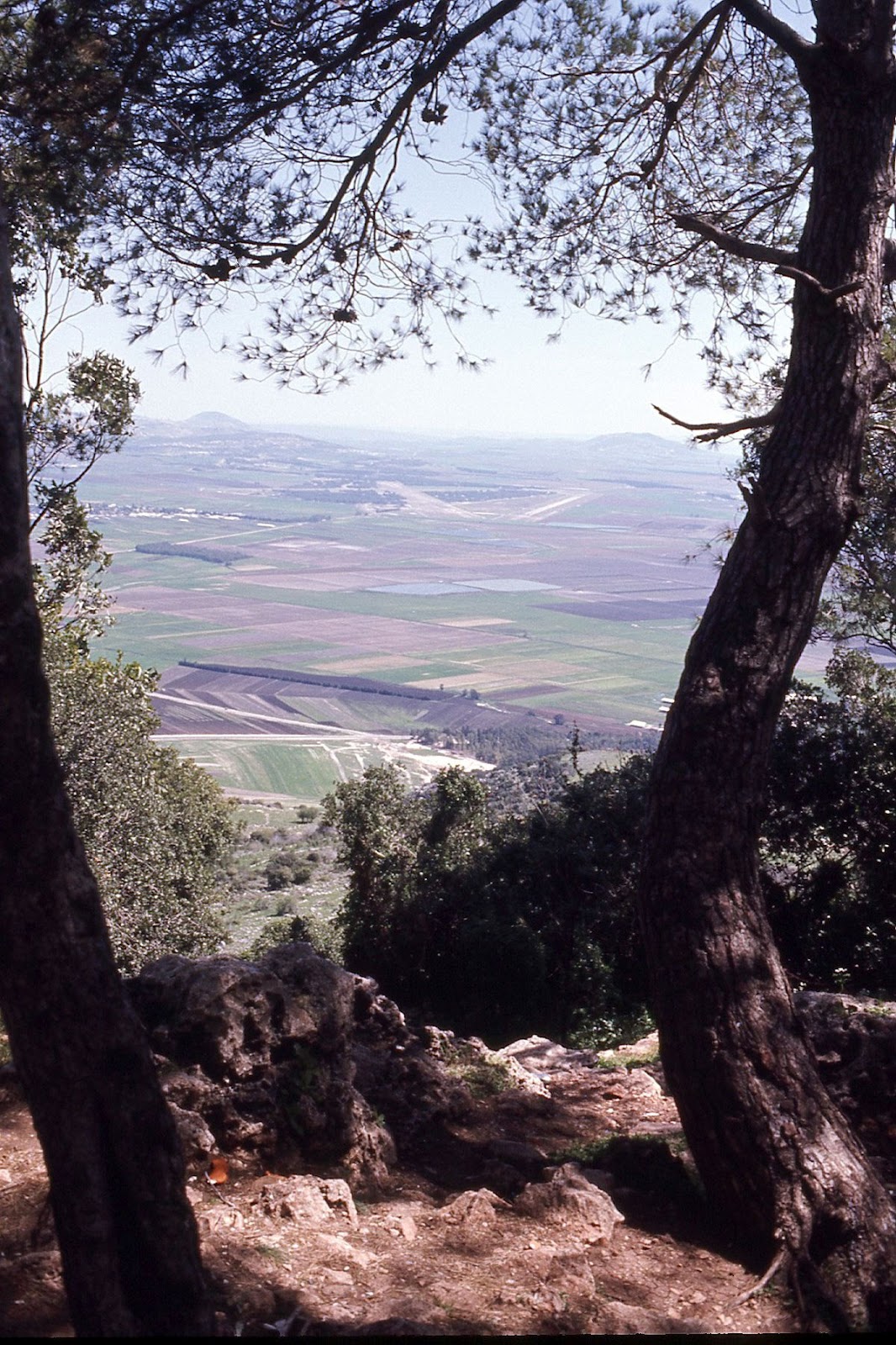
View of Plain
from Mt. Carmel
The trumpet blasts also assure the suffering saints that they will be victorious because the Lord will send out angels to gather them with a loud trumpet call (Matthew 24:31), and at that last trumpet call, the dead will be raised (1 Corinthians 15:52; 1 Thessalonians 4:16).
Each of the first four trumpet calls brings a plague on the earth similar to one of the plagues that fell on the Egyptians when God chastised them for afflicting his firstborn son (Exodus 4:22-23). He responds similarly against those afflicting his firstborn ones during this age. A third of the earth is burned up when the first trumpet is sounded (8:7). A third of the seas become blood and a third of the ships are destroyed (8:8-9) when the second trumpet is sounded. A third of the fresh waters are made bitter (8:10-11), and a third of the sun, moon, and stars are darkened for a third part of the day (8:12) when the third and fourth trumpets are sounded.
After that, John sees an eagle flying in the midst of the heavens. The eagle announces that the three calamities to follow will be even greater. He says, "Woe! Woe! Woe to the inhabitants of the earth, because of the trumpet blasts about to be sounded by the other three angels!"
God sees the suffering of his saints, hears their cries, and sends plagues on their enemies assuring the saints of eventual victory.
Monday, July 9, 2012
God Answers Prayer
Reflections on Revelation 8:2-5
Throughout this age, saints give their lives for the word of God and the testimony they give for Jesus as was seen in the fifth seal. The opening of the sixth and seventh seals assured the saints that those martyrs would be remembered: Christ would return to judge the nations and gather the elect. But, what about those who suffer and are not killed? God does not ignore their plight, does he? No, the new vision, a series of seven trumpet blasts, assures suffering saints that they, too, are remembered before God. He hears the prayers of suffering saints throughout this age. Thus, the sounding of the seven trumpets is roughly parallel with the opening of the seven seals.
The vision of the seven trumpet blasts is introduced with the prayers of the saints ascending before God with the incense which an angel offers on the golden altar. This altar is not the altar of sacrifice from which the martyrs cried out earlier. Instead, it corresponds to the golden altar of incense before the veil in the Holy Place of the temple in Jerusalem. This altar, however, stands before God in the true, heavenly temple not made with hands. An angel, not a descendant of Aaron, serves at this altar. The prayers refer to the prayers of those suffering for their faith in Jesus. Their prayers remind us of the cries of the Israelites in Egypt (Exodus 2:23-25). The rising of the incense before God in his heavenly temple assures the saints that God hears their prayers just as he heard the cries of the Israelites.
After the angel offers the incense, he fills the censer with fire from the altar and throws it on the earth, and there is thunder, lightening, and an earthquake (v. 5), which foreshadow the judgments which God will send upon the earth.
Throughout this age, saints give their lives for the word of God and the testimony they give for Jesus as was seen in the fifth seal. The opening of the sixth and seventh seals assured the saints that those martyrs would be remembered: Christ would return to judge the nations and gather the elect. But, what about those who suffer and are not killed? God does not ignore their plight, does he? No, the new vision, a series of seven trumpet blasts, assures suffering saints that they, too, are remembered before God. He hears the prayers of suffering saints throughout this age. Thus, the sounding of the seven trumpets is roughly parallel with the opening of the seven seals.
 |
| Model of Jerusalem; Herod's Palace with the Temple in the Background |
After the angel offers the incense, he fills the censer with fire from the altar and throws it on the earth, and there is thunder, lightening, and an earthquake (v. 5), which foreshadow the judgments which God will send upon the earth.
Thursday, July 5, 2012
Book on David's Life Now Available
The name of David, king of Israel, occurs in the Bible more than the name of any other person. The righteousness and equity of his reign became the standard by which all other kings were judged, and the standard he set is surpassed only by Jesus, the Messiah.
Reflections on the Life of King David is not a commentary in the sense of examining the text and explaining the meanings of the words and sentences. Instead, it examines a series of topics suggested by the text that are fitting for reflection and discussion. Hence, it provides discussion questions and personal reflections on short sections of Scripture, which will help people today to emulate David's good qualities and avoid his mistakes. At the same time, the book attempts to
Link to my publisher
I would appreciate reviews or ratings after you read the book. (Well positive ones anyway. I am not sure how my ego would take a negative review.) The book will also be available on Amazon.com in six to eight weeks.
 |
| City of David and Temple Mount, 1975 |
- Arrange events in David's life chronologically
- Estimate David's age for each of nine periods in his life
- Collate the events recorded in Samuel/Kings with the events recorded in Chronicles
Link to my publisher
I would appreciate reviews or ratings after you read the book. (Well positive ones anyway. I am not sure how my ego would take a negative review.) The book will also be available on Amazon.com in six to eight weeks.
Subscribe to:
Posts (Atom)